
Massachusetts Income Tax Rate For 2023
Massachusetts has one individual income tax bracket with a flat rate of 5%. Below you will find 2023 Massachusetts tax brackets and tax rates for all four MA filing statuses. The Massachusetts tax rate and tax brackets tabulated below are based on income earned between January 1, 2023 through December 31, 2023. Individual taxpayers will submit both their federal tax forms and state tax forms by April 15, 2024.
The Massachusetts state legislature steadily decreased the state tax rate by 0.05% per year since 2013 when the rate was 5.25%. A stronger economy in the state of Massachusetts had triggered the annual income tax rate reductions. Since 2020 the rate has been 5% which is the lowest rate currently allowed by state law. Outlook for the 2024 Massachusetts tax rate is to remain the same at 5% of taxable income.
Massachusetts Income Tax Calculation For $70,000 In Wages
- Tax Year: 2023
- Filing Status: Single
- Massachusetts Tax Rate: 5%
- Massachusetts Personal Exemption: $4,400
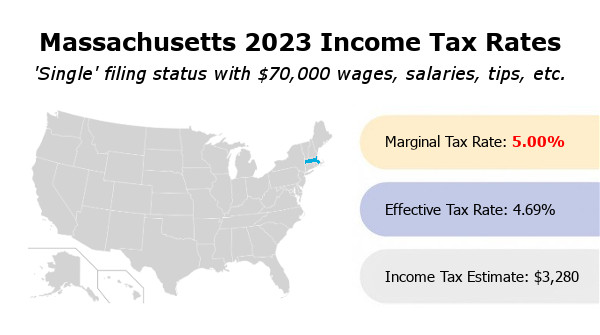
- Massachusetts Income Tax Estimate: $3,280
- Massachusetts Effective Tax Rate: 4.69%
To simplify and standardize the calculation across states, we assume the taxpayer has only income from Wages, salaries, tips, etc Line 1 on federal Form 1040. Massachusetts Form 1 begins with total federal income, 1040 Line 9. That means we must subtract the personal exemption amount of $4,400 from our 2023 wages. The result is our Massachusetts taxable income, which we can then multiply by the 2023 Massachusetts tax rate of 5%.
Massachusetts Income Tax = ( $70,000 - $4,400 ) × 5% = $3,280
To calculate the effective income tax rate for the state of Massachusetts, we simply divide the previously calculated income tax estimate by our initial $70,000 in wages.
Massachusetts Effective Tax Rate = $3,280 ÷ $70,000 = 4.69%
The actual amount of income tax you will pay in the state of Massachusetts will vary. Massachusetts, as with other states, often allow taxpayers to make additions and subtractions to their federal taxable income. Many states also offer credits for families with children, charitable contributions, and environmental initiatives, for example.
Massachusetts 2023 Income Tax Brackets by Filing Status
| Tax Bracket | Tax Rate |
|---|---|
| $0+ | 5% |
| Tax Bracket | Tax Rate |
|---|---|
| $0+ | 5% |
| Tax Bracket | Tax Rate |
|---|---|
| $0+ | 5% |
| Tax Bracket | Tax Rate |
|---|---|
| $0+ | 5% |
Please reference the Massachusetts tax forms and instructions booklet published by the Massachusetts Department of Revenue to determine if you owe state income tax or are due a state income tax refund. Massachusetts tax forms are generally published at the end of each calendar year, which will include any last minute 2023 - 2024 legislative changes to the MA tax rate or tax brackets. The Massachusetts tax brackets and tax rates calculated on this web page are to be used for illustration purposes only.
Frequently Asked Questions
Which Massachusetts tax bracket am I in?
In the state of Massachusetts there is just one personal income tax bracket. Every individual taxpayer is therefore in the same bracket regardless of filing status and amount.
What is the Massachusetts income tax rate for 2023?
Massachusetts's 2023 income tax rate is 5%.
Does Massachusetts have a millionaire tax?
Yes. Massachusetts passed a 4% millionaire tax which starts with the 2023 income tax year. Known as the Fair Share Amendment, the Massachusetts millionaire tax was approved by voters in November 2022. Taxable income over $1,000,000 will be taxed at the 4% rate. The $1,000,000 one million dollars income level will be adjusted annually to reflect any increases in the cost of living.
What is Massachusetts's marginal tax rate?
The current flat tax rate for Massachusetts is 5%. The Massachusetts marginal tax rate used in our example calculation above on this page is 5%. That is the tax rate applied to each additional dollar of taxable income you earn. Since Massachusetts is a flat tax rate state, the nominal or official tax rate equals the marginal tax rate.
What is Massachusetts's effective tax rate?
Massachusetts's effective tax rate is 4.69%. Effective tax rate equals the total tax paid divided by total taxable income. Find our Massachusetts tax rate calculations above on this page for more information.
How much state income tax will I pay in Massachusetts?
The national average adjusted gross income (AGI) reported by the IRS each year is about $70,000. A single Massachusetts taxpayer with $70,000 in wages would pay approximately $3,280 to the Massachusetts Department of Revenue. Find our Massachusetts tax rate calculations above on this page for more information.
Does Massachusetts have a standard deduction?
No. Massachusetts does not have a standard deduction for 2023.
Does Massachusetts have a personal exemption?
Yes. Massachusetts does have a personal exemption of $4,400 for a single person and $8,800 for a married couple.
Does Massachusetts have a dependent exemption?
Yes. Massachusetts does have a dependent exemption of $1,000 per dependent for 2023.
Is Massachusetts a flat tax state?
Yes. Massachusetts's state income tax rate is a flat 5% of your taxable income. Regardless of your income level, you will pay the same rate. There are nine flat tax rate states in the United States: Colorado, Illinois, Indiana, Kentucky, Massachusetts, Michigan, North Carolina, Pennsylvania, and Utah
Last updated: November 3, 2023
References:
- Rates of tax for residents, non-residents and corporate trusts. Massachusetts General Laws, Commonwealth of Massachusetts. Retrieved November 3, 2023.
- Amendments to the Massachusetts Constitution. Massachusetts General Laws, Commonwealth of Massachusetts. Retrieved November 3, 2023.
- Personal Income Tax for Residents. Massachusetts Department of Revenue, Commonwealth of Massachusetts. Retrieved November 3, 2023.
- View Massachusetts personal income tax exemptions. Massachusetts Department of Revenue, Commonwealth of Massachusetts. Retrieved November 3, 2023.
- Massachusetts tax rates. Massachusetts Department of Revenue, Commonwealth of Massachusetts. Retrieved November 3, 2023.