
Federal Income Tax Rates and Brackets for 2026
There are seven federal income tax brackets, with rates ranging from 10% to 37% for 2026. Use our federal income tax calculator to compare 2025 versus 2026 results by filing status and household income.

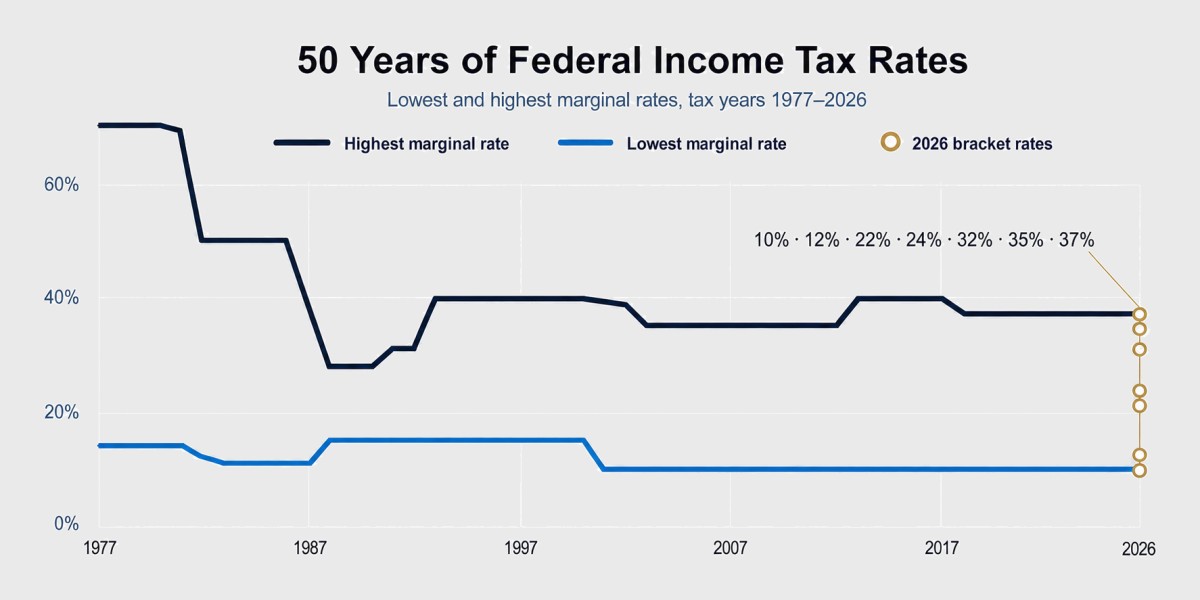
Over the last 50 tax years, the largest changes in federal individual income tax rates occurred during the 1980s. In 1977, statutory bracket rates ranged from 14% to 70%. Tax legislation enacted during the 1980s reduced the top statutory bracket rate to 50% beginning in 1982 and then to 28% by 1988, remaining at that level through 1990.
Since 1991, the top statutory rate has remained within a narrower range of 31% to 39.6%. For 2026, the seven federal marginal rates range from 10% to 37%. These rates apply to portions of taxable income and should not be confused with a household's effective tax rate, which also reflects deductions and credits. The calculator below shows how those pieces work together.
Calculator
Federal Income Tax Calculator: 2025 vs 2026
Use our federal income tax calculator to estimate your 2026 income tax, compare 2025 and 2026 results, and review the current federal income tax rates and brackets. Enter your household income, filing status, children, and deductions to see a detailed tax calculation, including estimated credits when applicable. Then use the tables and examples below to understand how the federal progressive tax brackets apply.
Federal Calculation Assumptions
Income:
- This calculator estimates a full-year US resident return filed on Form 1040. Nonresident and dual-status returns are not included.
- We treat household income as earned wage income. We do not separately calculate self-employment income, investment income, retirement income, capital gains, or other special income categories that require different tax treatment.
- The
Other Income Deductions
field under Advanced Options reduces federal adjusted gross income. See the input field tooltip for more details.
Deductions:
- For each year, the calculator compares the applicable standard deduction with allowed itemized deductions and uses the larger amount.
- Age 65+ and blindness selections increase the standard deduction amount when applicable.
- The federal enhanced senior deduction is calculated separately and may still apply when itemizing.
- Itemized deduction inputs group the main categories reported on Form 1040 Schedule A. Use prior-year amounts as a starting point and adjust for expected changes.
- Certain 2026 charitable-contribution and high-income itemized deduction limitations are not calculated.
- The calculator applies the separate 2025 and 2026 SALT limits and income-based phaseouts before adding deductible interest and other itemized deductions.
- Qualified tips, qualified overtime compensation, qualified car loan interest, and the enhanced senior deduction are treated as federal deductions after adjusted gross income.
Credits:
- We estimate the federal Child Tax Credit (CTC) and Additional Child Tax Credit (ACTC) for dependent children under age 17.
- We estimate the federal Earned Income Tax Credit (EITC) only when at least one dependent child under age 17 is entered. The estimate does not include the childless EITC or qualifying children who are older students or permanently disabled.
- We do not calculate the Saver's Credit, education credits, premium tax credits, or other federal credits.
Taxes Not Included:
- We do not calculate alternative minimum tax, self-employment tax, payroll taxes, capital gains tax, or net investment income tax.
- Withholding and estimated payments are not included, so the estimate is not a projected refund or balance due.
Actual results may vary based on your income type, additional deduction and credit limits, filing complexity, and continued changes in federal tax law. This calculator provides an estimate for general planning purposes and does not guarantee your final tax due or refund amount.
How the Federal Income Tax Calculator Works
The federal income tax calculator shows each major step from household income to estimated tax. Each column applies the corresponding year's tax brackets, deductions, SALT limits, and credit amounts to the same inputs, making it easier to compare 2025 and 2026. The comparison also includes deductions created by the One Big Beautiful Bill Act (OBBBA).
The final three rows summarize your federal results:
- Estimated Income Tax: Your federal income tax estimate for the year.
- Effective Tax Rate: Federal income tax as a percentage of household income.
- Marginal Tax Rate: The federal tax rate applied to your next dollar of taxable income.
Change any calculator input to see how it affects both years.
Tax Rates
Federal Income Tax Rates
The United States uses a progressive rate system to calculate federal individual income tax. Different portions of federal taxable income are taxed at different rates, called marginal tax rates. For 2026, seven marginal tax rates of 10%, 12%, 22%, 24%, 32%, 35%, and 37% apply to federal taxable income. The 2026 rates and corresponding brackets generally apply to income reported for the calendar year from January 1 through December 31, 2026. Most individuals will file their 2026 Form 1040 series returns during the 2027 filing season, generally from January through April.
2026 Federal Income Tax Brackets
| Rate | Single | Married Filing Jointly | Married Filing Separately | Head of Household |
|---|---|---|---|---|
| 10% | $0 - $12,400 | $0 - $24,800 | $0 - $12,400 | $0 - $17,700 |
| 12% | $12,401 - $50,400 | $24,801 - $100,800 | $12,401 - $50,400 | $17,701 - $67,450 |
| 22% | $50,401 - $105,700 | $100,801 - $211,400 | $50,401 - $105,700 | $67,451 - $105,700 |
| 24% | $105,701 - $201,775 | $211,401 - $403,550 | $105,701 - $201,775 | $105,701 - $201,750 |
| 32% | $201,776 - $256,225 | $403,551 - $512,450 | $201,776 - $256,225 | $201,751 - $256,200 |
| 35% | $256,226 - $640,600 | $512,451 - $768,700 | $256,226 - $384,350 | $256,201 - $640,600 |
| 37% | $640,601+ | $768,701+ | $384,351+ | $640,601+ |
The seven marginal tax rates remain unchanged from 2025. The One Big Beautiful Bill Act made the current rate structure permanent, while the taxable income thresholds are adjusted annually for inflation. Reaching a higher bracket does not cause all household income to be taxed at that rate. Each rate applies only to the portion of taxable income within its bracket.
The table above lists all seven federal income tax rates and the corresponding taxable income brackets for Single, Married Filing Jointly, Married Filing Separately, and Head of Household taxpayers. Use our federal income tax calculator at the top of this page to compare your estimated 2025 and 2026 results. The examples in the next section show how the 2026 brackets apply after deductions.
Examples
Federal Income Tax Calculation Examples
The goal of these examples is to isolate how the 2026 standard deduction and progressive federal income tax brackets affect taxpayers at the same income per person, without other deductions or tax credits obscuring the comparison. For that reason, the examples assume straightforward W-2 wage income, no dependents, no age or blindness deductions, no itemized or additional income deductions, and no tax credits. The Married Filing Jointly example uses twice the household income of the Single example. You can recreate both examples using the calculator above.
At-a-Glance Federal Calculator Comparison (2026 Tax Year)
| Income Tax Metric | Single | Married Filing Jointly |
|---|---|---|
| Household Income | $80,000 | $160,000 |
| Standard Deduction | $16,100 | $32,200 |
| Taxable Income | $63,900 | $127,800 |
| Tax Before Credits | $8,770 | $17,540 |
| Tax Credits | $0 | $0 |
| Federal Income Tax | $8,770 | $17,540 |
| Federal Effective Tax Rate | 10.96% | 10.96% |
| Federal Marginal Tax Rate | 22% | 22% |
A common misconception is that reaching a tax bracket causes all taxable income to be taxed at that rate.
Both examples reach the 22% bracket, but only the portion of taxable income above the applicable threshold is taxed at 22%.
The lower portions remain taxed at 10% and 12%.
In this simplified comparison, the joint household has twice the income, standard deduction, applicable bracket thresholds, and resulting federal income tax.
Both examples therefore have the same effective and marginal rates, so filing together does not create a federal marriage penalty
for this couple.
Next, we will review the step-by-step calculations for the Single and Married Filing Jointly examples.
Step-by-Step Example 1: Single
For a single filer with $80,000 of household income, the 2026 federal standard deduction is $16,100. Subtracting that deduction leaves $63,900 of federal taxable income.
That amount of taxable income reaches the 22% bracket, so the marginal tax rate is 22%. The full $63,900 is not taxed at that rate. Instead, each rate applies only to the portion of taxable income within that rate's bracket:
- Bracket 1 [$0 to $12,400]: The first $12,400 is taxed at 10%.
- Bracket 2 [$12,401 to $50,400]: The next $38,000 is taxed at 12%.
- Bracket 3 [$50,401 to $105,700]: The remaining $13,500 is taxed at 22%.
Federal tax before credits: $1,240.00 + $4,560.00 + $2,970.00 = $8,770.00.
Federal tax credits: This example assumes no Child Tax Credit, Additional Child Tax Credit, Earned Income Credit, or other federal tax credits.
Estimated federal income tax: With no credits, the estimated federal income tax remains $8,770.00.
Federal effective tax rate: 10.96%, calculated by dividing the estimated federal income tax of $8,770 by $80,000 of household income.
Federal marginal tax rate: 22% because the last dollar of taxable income falls within the 22% bracket.
Step-by-Step Example 2: Married Filing Jointly
Now let's apply the same calculation to a married couple filing jointly with $160,000 of household income, twice the income used in the Single example.
The 2026 federal standard deduction for Married Filing Jointly is $32,200. Subtracting that deduction leaves $127,800 of federal taxable income.
That amount of taxable income reaches the 22% bracket, so the marginal tax rate is 22%. The full $127,800 is not taxed at that rate. Instead, each rate applies only to the portion of taxable income within that rate's bracket:
- Bracket 1 [$0 to $24,800]: The first $24,800 is taxed at 10%.
- Bracket 2 [$24,801 to $100,800]: The next $76,000 is taxed at 12%.
- Bracket 3 [$100,801 to $211,400]: The remaining $27,000 is taxed at 22%.
Federal tax before credits: $2,480.00 + $9,120.00 + $5,940.00 = $17,540.00.
Federal tax credits: This example assumes no Child Tax Credit, Additional Child Tax Credit, Earned Income Credit, or other federal tax credits.
Estimated federal income tax: With no credits, the estimated federal income tax remains $17,540.00.
Federal effective tax rate: 10.96%, calculated by dividing the estimated federal income tax of $17,540 by $160,000 of household income.
Federal marginal tax rate: 22% because the last dollar of taxable income falls within the 22% bracket.
Conclusion
Federal Income Tax Takeaways
Tax brackets do not apply to your entire income: The 22% marginal rate in the examples applies only to taxable income above the applicable threshold. Lower portions remain taxed at 10% and 12%, while the standard deduction reduces the amount of income that reaches the brackets in the first place.
Deductions and credits affect federal income tax differently: Deductions reduce taxable income before the tax rates are applied. Tax credits are applied after the initial tax is calculated. This is why the calculator displays the standard deduction, taxable income, tax before credits, and tax credits as separate steps.
The Single and Married Filing Jointly examples produce the same effective rate:
At the income levels used in these examples, the joint household has twice the income, standard deduction, applicable bracket thresholds, and resulting federal income tax. Both examples therefore produce a 10.96% effective tax rate and a 22% marginal tax rate, with no federal marriage penalty
in this simplified comparison.
The seven federal income tax rates remain unchanged for 2026: The One Big Beautiful Bill Act made the current rates of 10%, 12%, 22%, 24%, 32%, 35%, and 37% permanent. The taxable income thresholds are adjusted annually for inflation, but the top marginal rate remains 37% for 2026.
FAQ
Frequently Asked Questions
What is the federal income tax rate for 2026?
For the 2026 tax year, the federal individual income tax rates are 10%, 12%, 22%, 24%, 32%, 35%, and 37%. These are marginal rates, meaning each rate applies only to the portion of taxable income within that bracket. The seven rates are unchanged from 2025, while the taxable income thresholds have increased for inflation.
What are the federal income tax brackets for 2026?
The 2026 federal income tax bracket thresholds depend on filing status. The highest 37% bracket begins at $640,601 for Single and Head of Household filers, $768,701 for Married Filing Jointly filers, and $384,351 for Married Filing Separately filers. Qualifying Surviving Spouse taxpayers use the Married Filing Jointly schedule.
Does the federal government have a millionaires tax?
No. Federal individual income tax does not include a separate millionaires tax
rate or bracket. For 2026, ordinary taxable income above the highest applicable threshold continues to be taxed at the top marginal rate of 37%. Some higher-income taxpayers may owe other federal taxes, including the net investment income tax or alternative minimum tax, which are not calculated here.
Does the federal income tax have a marriage penalty?
Federal income tax can produce a marriage penalty or marriage bonus depending on the couple's income and tax circumstances. In the simplified examples above, filing jointly produces no marriage penalty because the joint standard deduction and applicable bracket thresholds are twice the Single amounts. In other situations, upper bracket thresholds and certain deduction, credit, and additional tax limits are not always doubled for joint filers.
Does the federal government tax income from tips?
Yes. Tips remain reportable income for federal tax purposes. For 2026, eligible workers may claim a deduction for qualified tips received in eligible occupations, subject to the applicable annual limit and income-based phaseout. The deduction reduces taxable income but does not remove the requirement to report tip income. The calculator applies the deduction to qualified tips already included in household income.
Does the federal government tax overtime pay?
Yes. Overtime wages remain reportable income for federal tax purposes. For 2026, eligible workers may deduct qualified overtime compensation, generally the extra half of time-and-a-half pay required by federal law. The deduction does not apply to total overtime wages and remains subject to eligibility requirements, annual limits, and income-based phaseouts. In the federal income tax calculator, enter only the qualified overtime premium under Advanced Options.
Which One Big Beautiful Bill Act deductions does the calculator include?
The federal income tax calculator estimates deductions for qualified tips, qualified overtime pay, qualified car loan interest, and the enhanced deduction for seniors.
Open Advanced Options to enter tips, overtime, and car loan interest.
See the tooltips for eligibility details.
Select Age 65+ under Deduction Modifiers to estimate the enhanced senior deduction.
Despite the commonly used no tax on
labels, these provisions are deductions that reduce federal taxable income and remain subject to eligibility requirements, annual limits, and income-based phaseouts.
References:
- 2025 Instructions for Form 1040 and Form 1040-SR. Internal Revenue Service (IRS). Retrieved September 29, 2026.
- 2025 Instructions for Schedule A: Itemized Deductions. Internal Revenue Service (IRS). Retrieved September 29, 2026.
- Revenue Procedure 2025-32: Tax Year 2026 Inflation Adjustments. Internal Revenue Service (IRS). Retrieved September 29, 2026.
- Working Families Tax Cuts: Individuals and Workers. Internal Revenue Service (IRS). Retrieved September 29, 2026.
- Child Tax Credit. Internal Revenue Service (IRS). Retrieved September 29, 2026.
- Earned Income and Earned Income Tax Credit Tables. Internal Revenue Service (IRS). Retrieved September 29, 2026.
- Net Investment Income Tax. Internal Revenue Service (IRS). Retrieved September 29, 2026.
- Public Law 119-21 (H.R. 1). 119th United States Congress. Retrieved September 29, 2026.