
Utah Cuts Its Income Tax Rate to 4.45% for 2026
The rate reduction applies to the full 2026 tax year, saving $5 per $10,000 of Utah taxable income before credits.

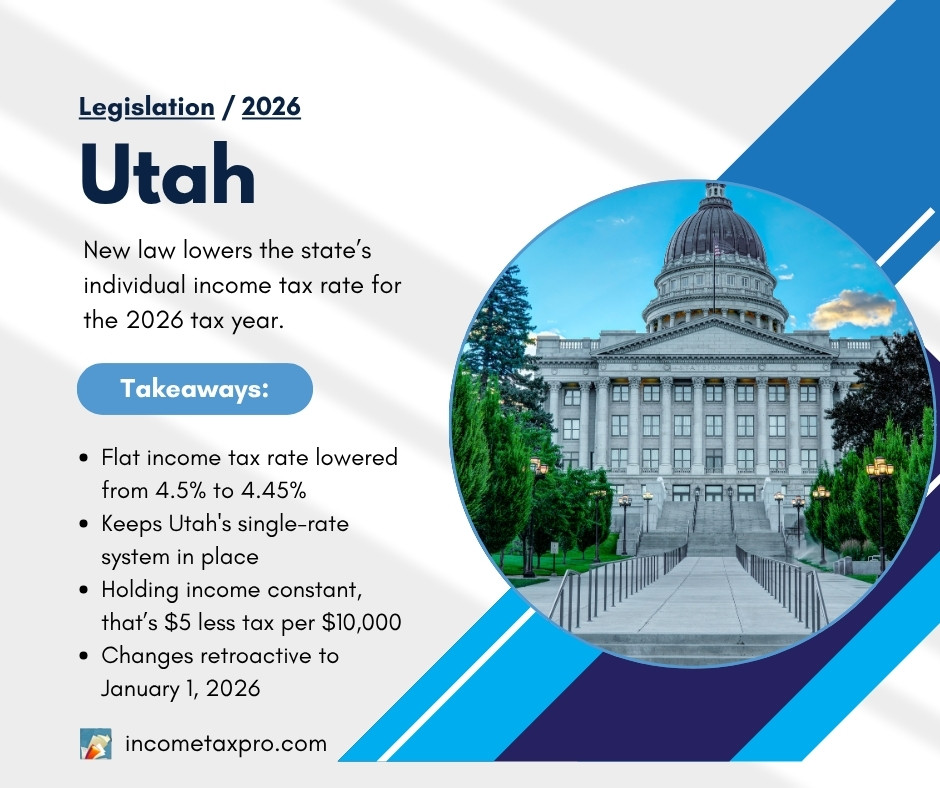
Utah Governor Spencer Cox signed Senate Bill 60 on March 23, lowering the state's individual income tax rate from 4.50% to 4.45% for 2026. The change trims the tax calculation by $50 for someone with $100,000 in Utah taxable income, before credits.
The law keeps Utah's single-rate system in place. It also reduces corporate franchise and income tax rates to 4.45%, but for households the key change is the rate applied to state taxable income on the individual return.
What Does the Lower Rate Save?
The reduction is 0.05 percentage points, or about 1.1% of the previous rate. Holding taxable income constant, that works out to $5 less tax for each $10,000 of Utah taxable income before credits.
| Utah Taxable Income | 2025 at 4.50% | 2026 at 4.45% |
|---|---|---|
| $50,000 | $2,250 | $2,225 |
| $100,000 | $4,500 | $4,450 |
| $150,000 | $6,750 | $6,675 |
Those examples produce reductions of $25, $50, and $75, respectively. They isolate the rate change, rather than predict a household's final tax bill or refund. Income changes and tax credits can alter the result.
Why the Taxpayer Tax Credit Still Matters
Utah starts its individual income tax calculation with federal adjusted gross income, then applies state additions and subtractions. The federal standard or itemized deduction generally enters a separate taxpayer tax credit calculation instead of being deducted directly from Utah taxable income.
That credit begins with 6% of qualifying deductions and Utah dependent exemption amounts, subject to adjustments. It shrinks as income rises above a filing-status threshold and can eventually disappear. The remaining credit reduces the tax calculated at the flat rate.
As a result, two households with the same taxable income can owe different amounts after credits. A taxpayer whose liability is already eliminated by nonrefundable credits may receive little or no additional benefit from the rate cut alone. The lower rate does not by itself create a refundable credit.
When Does the 4.45% Rate Apply?
Senate Bill 60 takes effect May 6, 2026, with retrospective operation for taxable years beginning on or after January 1, 2026. For calendar-year taxpayers, the new rate therefore applies to the entire 2026 tax year, including income earned before the signing.
The change belongs on the 2026 return, generally filed in 2027. Taxpayers filing their 2025 returns during 2026 still use the 2025 rate of 4.50%. A form's tax-year label matters more than the date it is downloaded or filed.
Our Utah income tax rate page explains the taxpayer tax credit and shows worked household examples, including the assumptions used. For available TC-40 returns and instructions, visit our Utah income tax forms page.
References:
- Governor Cox Signs 87 Bills in the 2026 General Legislative Session. March 23, 2026 signing announcement, including S.B. 60. Office of the Governor of Utah. Retrieved September 20, 2026.
- Senate Bill 60, Income Tax Rate Amendments (PDF). Sections 3-5 establish the individual rate, effective date, and retrospective application. Utah Legislature. Saved official copy reviewed September 20, 2026.
- 2025 TC-40 Line-by-Line Instructions. Income base and taxpayer tax credit mechanics. Cited for the calculation structure, not final 2026 indexed credit amounts. Utah State Tax Commission. Retrieved September 20, 2026.
- Utah Income Tax Rates. Historical rates, including 4.50% for 2025. The page remains labeled 2025. Utah State Tax Commission. Retrieved September 20, 2026.