
IRS Gives Drought-Affected Farmers More Time to Replace Livestock
Eligible farmers and ranchers facing a year-end replacement deadline have more time to rebuild their herds while deferring income tax on qualifying gains.

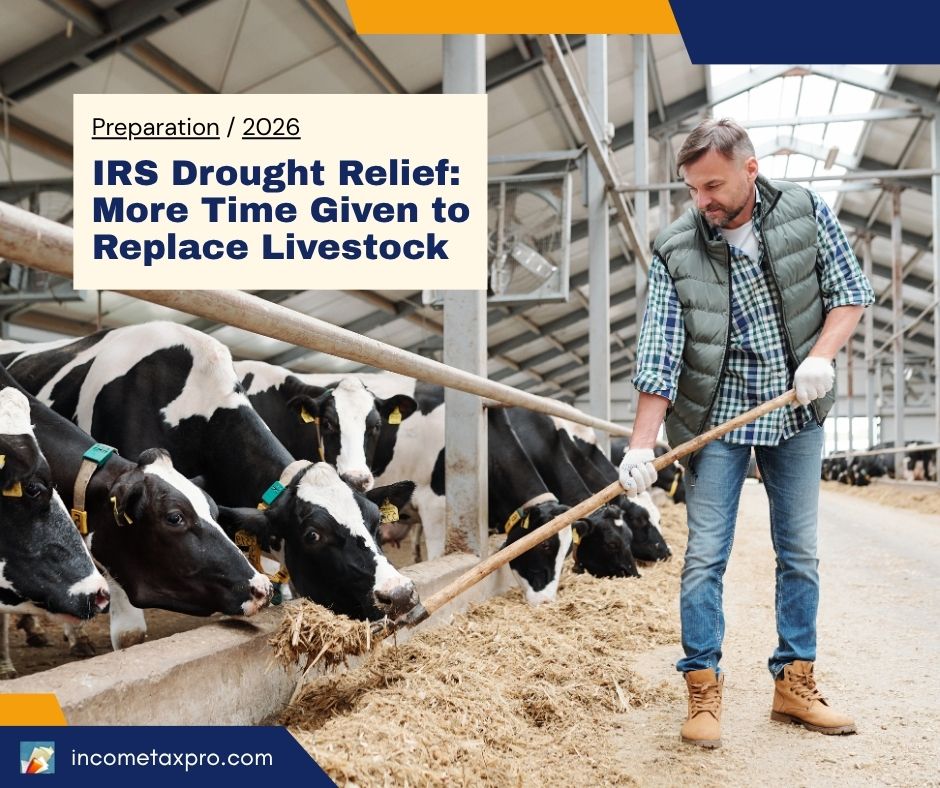
The Internal Revenue Service (IRS) is giving eligible farmers and ranchers more time to replace livestock sold because of drought. The September 15 announcement extends the replacement period used to defer income tax on qualifying gains. For eligible calendar-year taxpayers whose period ends December 31, 2026, the deadline now extends through at least December 31, 2027.
The relief addresses a problem that can continue long after a forced sale: drought may still prevent a producer from rebuilding the herd. The IRS identifies affected areas in 49 states, the District of Columbia, Puerto Rico, and other regions. Eligibility depends on the livestock, sale circumstances, and applicable area, rather than the state name alone.
Which Livestock Sales Qualify?
The replacement rules cover livestock held for breeding, dairy production, or draft purposes, meaning animals used for work. The qualifying sale must be caused solely by drought and involve more animals than the producer would normally sell under usual business practices.
The extended drought replacement period does not cover poultry, livestock raised for slaughter, or animals held for sporting purposes. A routine sale does not qualify simply because the farm is in an affected county. Taxpayers must meet the requirements for the four-year replacement period, including the federal assistance designation tied to the drought.
Check the County List and the Replacement Deadline
The Internal Revenue Service's Notice 2026-54 lists counties and other jurisdictions with severe, extreme, or exceptional drought during the year ending August 31, 2026. The applicable region includes the county where drought caused the sale and its neighboring counties. A listed county anywhere in that region can support the extension.
For example, an eligible calendar-year rancher who realized a qualifying gain in 2022 would ordinarily reach the end of the four-year replacement period on December 31, 2026. If the applicable region qualifies under the new notice, that rancher has through at least December 31, 2027 to buy replacements.
The period can extend further if drought persists. Under the continuing relief rules, it ends with the taxpayer's first tax year ending after the region's first drought-free year. The IRS measures that drought-free year over a 12-month period ending August 31. Fiscal-year taxpayers should check their own year-end rather than assume the December date applies.
Extra Time to Replace Livestock, Not to File a Return
This announcement extends the livestock replacement period. It does not by itself postpone income tax return or payment deadlines. Deferring the gain also requires following the replacement and reporting rules, not simply keeping the sale proceeds.
To defer the entire qualifying gain, the cost of eligible replacement property generally must equal or exceed the proceeds from the qualifying sale. Spending less can leave part of the gain taxable. Keep the sale records, evidence of the drought-related circumstances, the applicable county information, and records of replacement purchases together.
The IRS explains the election and required return statements in Publication 225, Farmer's Tax Guide. Its replacement rules are separate from another provision that may let qualifying farmers postpone certain weather-related livestock income until the following year.
Use the Right Forms for the Farm Return
Sales of livestock held for breeding, dairy, or draft purposes generally belong on Form 4797, rather than Schedule F. Those gains also generally fall outside self-employment earnings when the animals were not held primarily for sale to customers. The drought relief does not make every livestock sale ordinary farm income.
For the rest of an individual farmer's return, our Schedule F forms and instructions page covers reporting farm income and expenses. Our Schedule SE forms and instructions page helps with self-employment tax on applicable net earnings. Use the editions for the tax year you are reporting, which may differ from the year you replace the livestock.
References:
- IRS Announces Extension of Tax Relief for Farmers and Ranchers Affected by Drought in 49 States, Other Regions. IR-2026-110, September 15, 2026. Announcement, covered livestock, and additional replacement time. Internal Revenue Service. Retrieved September 30, 2026.
- Notice 2026-54: Extension of Replacement Period for Livestock Sold on Account of Drought. Sections 2-3 and appendix. Qualifying sales, replacement rules, and the 2026 county list. Internal Revenue Service. Retrieved September 30, 2026.
- Notice 2006-82: Extension of Replacement Period for Livestock Sold on Account of Drought. Sections 3-4. Applicable region, drought-free year, and an example of continuing extensions. Internal Revenue Service. Retrieved September 30, 2026.
- Publication 225: Farmer's Tax Guide. 2025 edition, chapters 3, 11, and 12. Separate weather-related sale provisions, replacement elections and reporting, and self-employment earnings. Use Notice 2026-54 for the current county list. Internal Revenue Service. Retrieved September 30, 2026.
- Instructions for Schedule F (Form 1040). 2025 edition. Farm income reporting, other forms including Form 4797, and Schedule SE connections. Internal Revenue Service. Retrieved September 30, 2026.